How to Get Started in Amateur Radio
Two things should be mentioned before we get started. First, amateur radio is a hobby full of other hobbies. One ham (nickname for amateur operator) told me “If you get bored in this hobby, you are not trying”. Second, ham is actually an acronym: Had A lot of Money. While radio can be expensive, hams have long prided themselves on what they can make work on a shoestring budget.
An FCC license is REQUIRED to transmit (push the button), however, you can listen all you want. A license is not required to purchase or possess amateur radios. There are 3 levels of licensure in amateur radio: Technician, General and Extra, in that order. Each license grants more band privileges.
There are many ways to learn how to pass the FCC amateur radio operators license tests. YouTube has many presentations, an online method is to take practice tests on hamstudy.org and there are study guides and classes available from many sources. The ARRL (Amateur Radio Relay League, arrl.org) is an organization that provides information and legislative representation for amateurs.
The Richfield Amateur Radio Club is located in a first ring suburb of the Twin Cities in Minnesota. People in this area often start with the FM mode on the VHF and UHF frequencies. Two terms I will introduce at this point are Simplex and Duplex. Simplex is communication between two or more stations directly, and duplex uses a repeater (usually a station mounted at a high location with greater power. Please see the graphic below to show what a repeater does. There are more than 28 VHF FM repeaters and more than 42 UHF FM repeaters in the metro area. This means you can potentially talk to a large number of people with a simple HT (Handi-Talkie), available for as little as $16 USD. An HT will not transmit very far, so repeaters are often used. Activities found in this area are informal conversations (rag chewing), Local club networks (nets) at scheduled days and times, emergency nets, such as SkyWarn, ARES and others. Something that is an issue is jargon. There are abbreviations, terms, and phonetics that are not part of regular conversation.
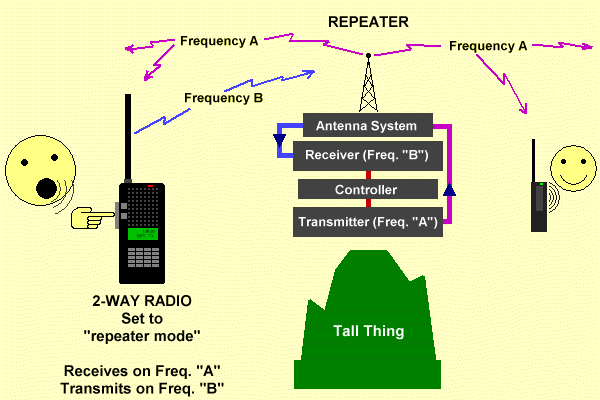
This is a very simplified explanation of how a repeater works. In the example above, you push the button and transmit on frequency B (blue). The repeater receives frequency B and re-transmits it as frequency A (red) where another station receives the transmission. If the other station wants to reply, they push the button and their radio transmits on frequency B, and it goes through the repeater, and you receive on frequency A. Each radio has the function of receiving on a programmed frequency, and transmitting on a different frequency. The difference in the two frequencies is called the offset. There are parameters involved with using a repeater that are user set in the radio. Some other terms are tone, pl tone, DCS. These will be be discussed in another posting. Refer to https://www.repeaterbook.com/repeaters/Display_SS.php?state_id=27&band=4 for examples of Minnesota 2 meter band repeater parameters.
Here is an example of the RARC net:
The ARRL Operating Manual for Radio Amateurs; Volume 1 and 2 can be purchased as a paperback book or, the Kindle version is $10 USD for volumes 1 and 2, another $10 for 3 and 4 on that website named after a river in South America.